Have you ever wondered about the cute, fluffy rabbits hopping around in fields? The European rabbit is one of the most well-known rabbit species in the world. These small mammals have an amazing story that includes both survival struggles and incredible success. Whether you are a student learning about animals or just curious about wildlife, this guide will help you understand everything about these fascinating creatures.
In this article, you will discover where European rabbits come from, how they live, what they eat, and why they are both endangered in some places and considered pests in others. Let us explore the fascinating world of these extraordinary creatures!
What is a European Rabbit?
The European rabbit, scientifically known as Oryctolagus cuniculus, is a small mammal native to the Iberian Peninsula of southwestern Europe. It is the sole ancestor of all domestic pet rabbit breeds kept around the world today. Adults typically measure around 16 inches in length and weigh between 2.6 to 4.4 pounds, with soft grayish-brown fur and distinctive lighter underparts.
Quick Facts About European Rabbits
| Feature | Details |
| Scientific Name | Oryctolagus cuniculus |
| Average Size | 16 inches (40 cm) |
| Weight | 2.6–4.4 pounds (1.2–2 kg) |
| Lifespan (Wild) | 1–2 years |
| Lifespan (Captivity) | 8–12 years |
| Conservation Status | Endangered in native range (IUCN) |
| Activity Pattern | Crepuscular (dawn and dusk) |
Physical Characteristics and Appearance
European rabbits have several features that make them easy to identify. Their ears are shorter than a hare’s and usually measure about 2.6 to 3 inches long. Unlike hares, which have black-tipped ears, rabbit ears are brown.
A rabbit’s coat color often shifts based on its surrounding habitat. Most have a grayish-brown coat on their back with a distinctive reddish-ginger patch on the back of their neck. Their belly is typically a lighter blue-gray color. The tail is dark on top and white on the underside.
Key physical features include:
- Round, compact body shape
- Short, rounded ears
- Dark brown eyes
- Strong hind legs for quick escapes
- Soft, dense fur for insulation
Male rabbits tend to be slightly heavier and more muscular than females. These physical traits help them survive in the wild by allowing them to hide from predators and stay warm in different weather conditions.
Natural Habitat and Distribution
The European rabbit’s story begins in the Iberian Peninsula, which includes Spain and Portugal. These lagomorphs underwent millions of years of evolutionary development within this specific geographic region. They prefer areas with short grass for eating and bushes or underground burrows for hiding from danger.
Today, according to the American Pet Products Association (APPA) National Pet Owners Survey, roughly 6.7 million pet rabbits are kept in US households — a testament to how deeply this species has embedded itself in American family life.
Preferred habitats include:
- Grasslands with good drainage
- Sandy soil areas (like sand dunes)
- Edge of forests and woodlands
- Agricultural fields
- Areas near human settlements
These rabbits dig complex underground tunnel systems called warrens. A warren can have multiple rooms and several entrance and exit holes. This underground home protects them from predators like foxes, hawks, and wildcats, and keeps them safe from extreme heat in summer and cold in winter. The warren system demonstrates remarkable spatial intelligence — rabbits create specific chambers for resting, raising young, and storing soft nesting materials.
Behavior and Social Life

European rabbits are very social animals. They live in groups of 2 to 10 individuals inside their warrens. Each group has one dominant male (called a buck) and several females (called does) along with some subordinate males.
Their peak activity levels occur around sunrise and sunset — a pattern called being “crepuscular.” They choose these times because there is enough light to see but many predators are less active.
Interesting behaviors include:
- Marking territory with chin glands and dung piles
- Thumping their back feet to warn others of danger
- Zigzag running patterns to confuse predators
- Staying within 80 feet of their burrow when feeding
- Sleeping with eyes open to watch for threats
Research published in the journal Urban Ecosystems has documented that urban rabbit populations can reach significantly higher densities than rural ones — up to 14.72 individuals per hectare in urban environments compared to just 0.80 per hectare in rural areas. This finding shows that rabbits are adapting remarkably well to life near humans in cities.
Diet and Feeding Habits

European rabbits are strict herbivores, meaning they only eat plants. Their favorite foods are fresh grasses, especially young, tender shoots. They are selective eaters who choose the most nutritious plants available.
Their diet includes:
- Various types of grass (especially fescue)
- Leafy greens and herbs
- Young plant shoots
- Tree bark (especially in winter)
- Root vegetables and crops
- Berries (occasionally)
One important but surprising behavior is called coprophagy — rabbits eat a specific type of their own droppings called cecotropes. These soft, nutrient-rich pellets contain important vitamins including B12 that their bodies cannot fully absorb during the first pass through digestion. It is nature’s way of ensuring complete nutrition.
Rabbits have a unique digestive system. They can only digest about 20% of the fiber they eat in a single pass, which is why coprophagy is essential, not optional. During winter when food quality drops, rabbits work harder to find nutrition and may lose significant body weight.
Reproduction and Life Cycle
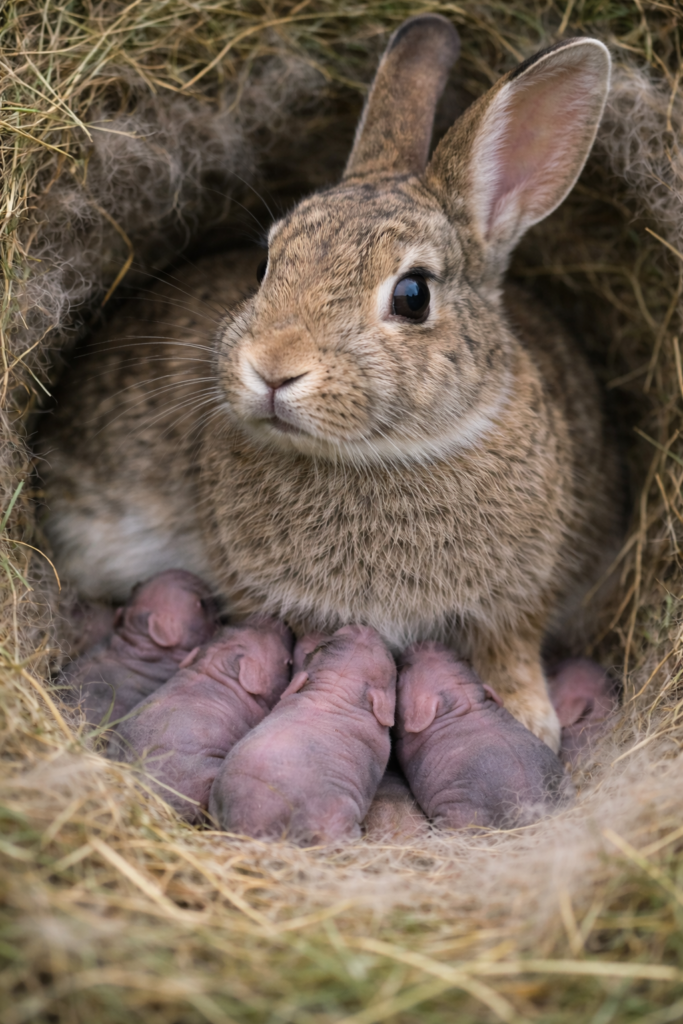
Female rabbits can start having babies when they are just 3 to 4 months old. The pregnancy (gestation) lasts only 31 days. Each litter can have anywhere from 2 to 12 babies, with an average of 5. A female can have 4 to 7 litters per year.
Reproduction facts:
- Breeding season: Autumn through spring (sometimes summer)
- Number of babies per year: 30–40 from one pair
- Baby rabbits are called “kittens”
- Kittens are born blind, deaf, and hairless
- Eyes open after 11 days
- Weaned at 4 weeks
- Ready to reproduce at 4 months
Doe rabbits typically spend very little time in the nest each day to avoid attracting predators — visiting only once or twice daily for a few minutes to nurse. In the wild, about 75% of rabbits do not survive their first three months. Those that do typically live 1 to 2 years due to predators, diseases, and harsh weather. However, pet rabbits in safe homes can live 8 to 12 years, and some reach 14 years.
European Rabbit as an Invasive Species
While European rabbits are endangered in their native Spain and Portugal, they have become serious pests in other parts of the world. Starting from the first century BCE, humans introduced rabbits to new areas for food and sport hunting.
The most famous example is Australia. In 1859, just 24 rabbits were released — within 100 years, the population had exploded to over 600 million.
Problems caused by invasive rabbits include:
- Competing with native animals for food
- Destroying crops and farmland
- Causing soil erosion
- Eating plants that native animals need
- Threatening agricultural industries
In Australia, New Zealand, and parts of South America, rabbits have damaged ecosystems so severely that they are listed among the world’s 100 worst invasive species. Control efforts have included fences, hunting, and the introduction of rabbit-specific diseases.
Predators and Threats

In their natural habitat, European rabbits face dangers from more than 45 different predator species.
Natural predators include:
- Foxes
- Wildcats and domestic cats
- Dogs
- Weasels and stoats
- Badgers
- Birds of prey (hawks, eagles, owls)
- Large gulls
However, the biggest threats come from two viral diseases that have devastated rabbit populations:
- Myxomatosis: Causes severe swelling of the eyes, nose, and genitals. In the 1950s, this disease killed 99% of Britain’s rabbit population within just two years.
- Rabbit Hemorrhagic Disease (RHD): Damages vital organs including the liver and blood vessels, causing dangerous internal bleeding. A new variant emerged and contributed to the IUCN listing the species as Endangered in 2019.
These diseases do not just affect rabbits. Over 40 species depend on rabbits as their main food source — including the critically endangered Iberian lynx and Spanish imperial eagle. When rabbit numbers drop, these predators suffer too.
Conservation Status and Current Challenges
The European rabbit faces a conservation paradox. In its native range of Spain and Portugal, populations have declined by 90% over the past 70 years due to habitat loss, disease, and changing farming practices.
Currently, the IUCN Red List classifies the European rabbit as Endangered in its native range. Meanwhile, in places where it was introduced — like Australia — it remains a serious pest.
Conservation efforts include:
- Monitoring programs across the Iberian Peninsula
- Habitat restoration projects
- Disease management and vaccine development
- Coordinated management between Spain and Portugal
- Agricultural policies that support rabbit populations
The LIFE Iberconejo project represents a major recent conservation effort. In 2024, teams tracked over 4,600 kilometers searching for rabbits and collecting population data. This information will help create better long-term protection strategies.
The challenge is balancing conservation in native areas while controlling invasive populations elsewhere — a reminder that the same species can be both threatened and threatening, depending on where it lives.
Frequently Asked Questions
Q: Are European rabbits good pets?
A: Domestic rabbits descended from European rabbits are fantastic companions. They are naturally social, learn litter box habits easily, and build deep, affectionate connections with their human families. However, they require proper care, space, and regular veterinary attention from an exotic animal vet.
Q: How fast can European rabbits run?
A: While not as fast as hares, European rabbits can reach speeds of about 25 miles per hour in short bursts. Their zigzag running pattern helps them confuse and escape predators.
Q: Do European rabbits hibernate?
A: No, European rabbits do not hibernate. During winter, they stay in their insulated burrows, huddle together for warmth, and venture out less frequently to feed.
Q: Can European rabbits swim?
A: Yes, they can swim if necessary, but they strongly prefer not to. Drowning is actually one of the documented causes of death in wild populations, particularly during floods.
Q: Why do rabbits thump their feet?
A: Foot thumping is a warning signal. When a rabbit senses danger, it thumps its powerful hind legs on the ground to alert other rabbits in the warren immediately.
Conclusion
The European rabbit is truly a remarkable species with a complex global story. From its origins in the sunny hills of Spain and Portugal, this small mammal has spread across the world — sometimes as a beloved pet, sometimes as a devastating invasive species, and sometimes as a critically endangered native animal all at once.
Today, we face the challenge of protecting European rabbits in their native home while managing their impact in places where they have become invasive. Whether you see a wild rabbit hopping through a field or cuddle with a pet bunny at home, remember that you are looking at a species that has shaped landscapes, fed countless predators, and captured human hearts for thousands of years. Understanding and protecting the European rabbit means protecting the delicate balance of nature itself.